
Bloating, gas, abdominal pain or diarrhoea after drinking milk can quickly raise a question: Could I be lactose intolerant?
Lactose intolerance is relatively common in the Baltic region, but giving it one definitive prevalence figure is not as straightforward as it may seem. Studies from Estonia, Latvia and Lithuania show that the answer depends on what exactly is being measured – genetic predisposition, lactose absorption or the symptoms actually experienced by the individual.
And these three things are not quite the same.
What happens in the body in lactose intolerance?
Lactose, the natural sugar found in milk, consists of glucose and galactose. To digest it, the body needs an enzyme called lactase, which is produced in the lining of the small intestine.
Lactase activity is usually high during infancy. In many people, however, it begins to decline after childhood as part of a genetically programmed process. This is known as lactase non-persistence, or adult-type hypolactasia.
When there is insufficient lactase, not all of the lactose consumed is broken down in the small intestine. Some of it reaches the large intestine, where it is fermented by intestinal bacteria. This process may lead to gas, bloating, abdominal pain and diarrhoea.
There is, however, an important distinction to make:
Low lactase activity does not automatically mean lactose intolerance.
The term lactose intolerance generally refers to a situation in which consuming lactose causes actual gastrointestinal symptoms.
How common is lactase non-persistence in Estonia, Latvia and Lithuania?
Genetic studies of Baltic populations suggest that a substantial proportion of people experience a decline in their ability to digest lactose after childhood.
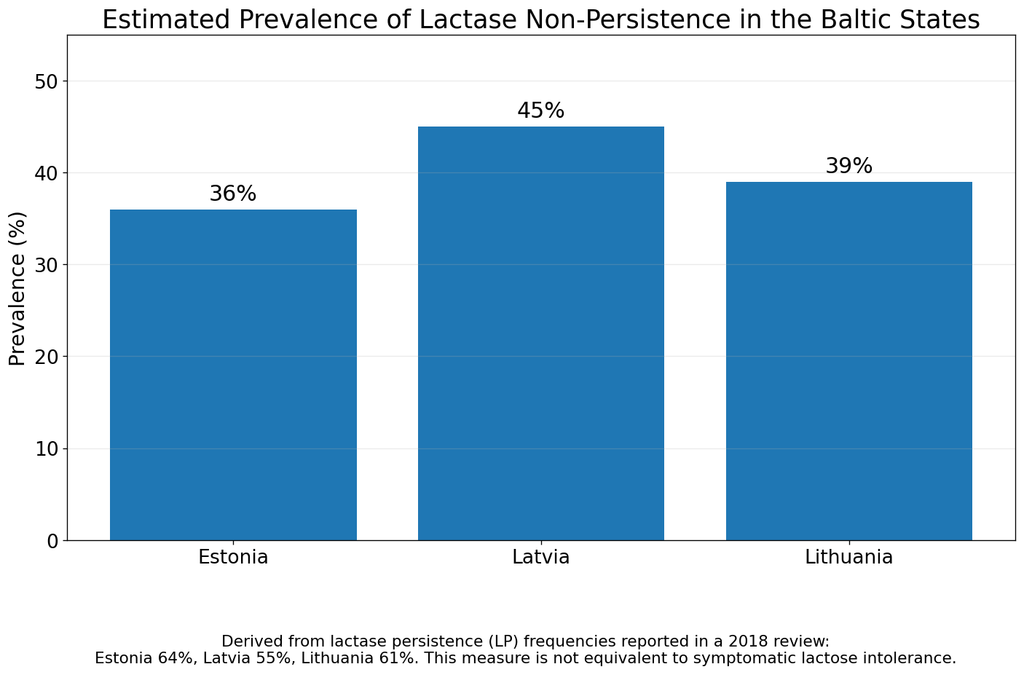
According to estimates presented in a 2018 review of Latvian population genetics, the prevalence of lactase persistence was approximately 64% in Estonia, 55% in Latvia and 61% in Lithuania.
Viewed from the opposite perspective, this corresponds to estimated rates of lactase non-persistence of approximately:
Estonia – 36%
Latvia – 45%
Lithuania – 39%
However, these figures do not mean that 36% of Estonians or 45% of Latvians experience symptoms of lactose intolerance. They describe population-level estimates of lactase persistence and non-persistence rather than the prevalence of clinically symptomatic lactose intolerance.
This distinction is behind much of the confusion surrounding statistics on lactose intolerance.
The Estonian study: genes do not determine everything
In an Estonian study published in 2006, genetic variants associated with lactase persistence were analysed in 355 individuals. Based on ethnic background, 314 ethnic Estonians were included in the prevalence analysis.
The C/C−13910 genotype, associated with lactase non-persistence, was found in 24.8% of Estonians. The C/T genotype occurred in 47.5% and the T/T genotype in 27.7%.
The researchers also examined participants’ milk consumption.
People with the C/C−13910 genotype drank less milk on average and reported milk-related symptoms more frequently. However, not everyone with this genotype avoided milk or experienced symptoms after drinking it.
This is an important observation.
Genetics may increase the likelihood of poor lactose digestion, but genes alone cannot tell us exactly how someone will feel after drinking a glass of milk.
The Lithuanian study shows why the percentages can differ
A Lithuanian study published in 2007 examined 120 healthy young people using both genetic analysis and a lactose tolerance test.
According to the lactose tolerance test, low lactase activity was found in 31.7% of the entire study group. Among ethnic Lithuanian participants, the prevalence of primary adult-type hypolactasia based on the lactose tolerance test was 27.8%.
The genetic analysis, however, produced a different result.
The C/C−13910 genotype, associated with lactase non-persistence, was identified in 44.3% of ethnic Lithuanian participants.
At first glance, 27.8% and 44.3% may appear contradictory. In fact, they demonstrate very well why different sources may provide quite different figures for the prevalence of lactose intolerance.
A genetic test, a lactose tolerance test and a person’s own symptoms measure different things.
There are differences within Latvia as well
A 2018 review of Latvian population genetics examined the frequency of the MCM6 −13910*T allele associated with lactase persistence in 277 Latvians.
Its frequency varied between regions:
North-western Latvia – approximately 37%
Central Latvia – approximately 32%
South-western Latvia – approximately 34%
Eastern Latvia – approximately 30%
The authors estimated the prevalence of lactase persistence in the Latvian population at approximately 55%.
This suggests that even within a relatively small country, genetic variants associated with lactose digestion may not be distributed completely uniformly.
Why do Northern Europeans tolerate lactose relatively well?
This is where the story of lactose digestion becomes particularly fascinating.
From an evolutionary perspective, the ability to digest fresh milk throughout adulthood is not something we should necessarily take for granted.
In our ancestors, lactase production generally declined after the breastfeeding period. As animal husbandry and the use of milk as food became widespread in Europe, the ability to digest fresh milk in adulthood probably provided an advantage in certain populations.
Over generations, genetic variants that allowed lactase activity to persist into adulthood therefore became increasingly common.
Ancient DNA studies show that lactase persistence, which is relatively common in Northern Europe today, was not always widespread in this region. Its frequency increased alongside changes in European populations, lifestyles and food culture.
A simple glass of milk can therefore tell a surprisingly long story about our ancestors.
Does lactose intolerance mean giving up dairy products?
Not necessarily.
Lactose tolerance is not simply a “yes or no” characteristic. Whether symptoms occur can be influenced by the amount of lactose consumed, the composition of the meal, the type of dairy product, the intestinal microbiome and individual sensitivity.
Someone who experiences discomfort after drinking a glass of ordinary milk may be able to eat yoghurt or low-lactose cheeses without difficulty. Another person may tolerate a small amount of milk with a meal but experience symptoms after consuming a larger amount at once.
Instead of asking only:
“Am I lactose intolerant?”
it may sometimes be more useful to ask:
“How much lactose can my body actually tolerate?”
If symptoms are recurrent or severe, it is worth discussing them with a doctor or another healthcare professional, as gastrointestinal symptoms may have causes other than lactose intolerance.
How is lactose intolerance investigated?
Experiencing repeated bloating, gas, abdominal pain or diarrhoea after consuming dairy products does not automatically confirm lactose intolerance. Similar symptoms can occur with a number of other gastrointestinal conditions.
There are several ways to investigate a person’s ability to digest lactose.
One option is a genetic test, which examines genetic variants associated with lactase persistence. It can indicate whether a person has a hereditary predisposition to adult-type decline in lactase activity. However, a genetic test cannot directly determine whether symptoms will occur after consuming lactose or how severe those symptoms may be. It also does not identify every possible cause of secondary lactase deficiency.
Another option is a lactose challenge or lactose tolerance test, in which a defined amount of lactose is administered and the body’s response is subsequently assessed.
Today, the hydrogen breath test (H₂ breath test) is commonly used to investigate lactose malabsorption.
At the beginning of the test, the concentration of hydrogen in exhaled air is measured. The person then drinks a solution containing a defined amount of lactose, and breath samples are taken repeatedly over the following hours.
If lactose is not adequately broken down and absorbed in the small intestine, it reaches the large intestine. There, intestinal bacteria ferment the lactose and may produce hydrogen. Some of this hydrogen is absorbed into the bloodstream, transported to the lungs and exhaled.
An increase in hydrogen concentration in exhaled air after lactose ingestion may therefore indicate lactose malabsorption.
Symptoms are usually monitored during the test as well. This is important because a positive test for lactose malabsorption and symptomatic lactose intolerance are not exactly the same thing.
Why is a lactose solution used for testing?
For a lactose challenge, it is important that the person receives a known and accurately measured amount of lactose. A lactose-containing test solution can be used for this purpose.
LactoTest, available from Sugarmill, is a ready-to-drink 300 ml lactose solution containing 50 g of lactose. A pre-measured solution makes it easier to standardise the lactose challenge and eliminates the need to weigh and dissolve lactose powder on site.
It is important to remember that the test solution itself does not provide a diagnosis. It is a tool used to administer the lactose challenge; interpretation of the results depends on the diagnostic method used and the assessment of a healthcare professional.
This brings us back to the same point highlighted by the Baltic studies: genetic predisposition, lactose malabsorption and the symptoms experienced by an individual each provide somewhat different information.
What do the Baltic studies ultimately tell us?
Studies from Estonia, Latvia and Lithuania do not reveal a simple dividing line between people who “tolerate” lactose and those who “do not”.
Instead, we see a spectrum.
At one end are people whose lactase activity remains high throughout adulthood. At the other are those for whom even a relatively small amount of lactose may cause uncomfortable symptoms. Between these groups are many people whose tolerance depends on the amount consumed, the food in which lactose is present and the circumstances in which it is eaten.
For this reason, the result of a lactose intolerance investigation should also be considered alongside the person’s actual symptoms and dietary habits.
A laboratory result gives us one part of the answer. The body’s own response tells the rest of the story.
Did you know?
• Lactose is a naturally occurring sugar found in milk.
• Lactase is the enzyme that helps the body digest lactose.
• Lactase activity may decrease with age.
• A genetic predisposition does not automatically mean that symptoms will occur.
• Lactose tolerance may depend on the amount consumed at one time.
• Both genetic and functional tests can be used when investigating lactose intolerance.
• A hydrogen breath test assesses the body’s response following a lactose challenge.
• Lactose intolerance does not always mean that all dairy products need to be eliminated from the diet.
References
Lember M, Torniainen S, Kull M, et al. (2006). Lactase non-persistence and milk consumption in Estonia. World Journal of Gastroenterology, 12(45), 7329–7331.
Kalibatienė D, Varvuolytė S. (2007). Detection of the C/C−13910 genotype associated with primary adult-type hypolactasia. Biologija, 53(3), 25–29.
Krūmiņa A. et al. (2018). Population Genetics of Latvians in the Context of Admixture between North-Eastern European Ethnic Groups. Proceedings of the Latvian Academy of Sciences, Section B, 72(3), 131–151.
Saag L. et al. (2019). The Arrival of Siberian Ancestry Connecting the Eastern Baltic to Uralic Speakers Further East. Current Biology.
Ingram CJE, Mulcare CA, Itan Y, Thomas MG, Swallow DM. (2009). Lactose digestion and the evolutionary genetics of lactase persistence. Human Genetics, 124, 579–591.